Showing posts with label jupter conjunct uranus. Show all posts

Sunday, February 6, 2011

Challenge Find the Bubble


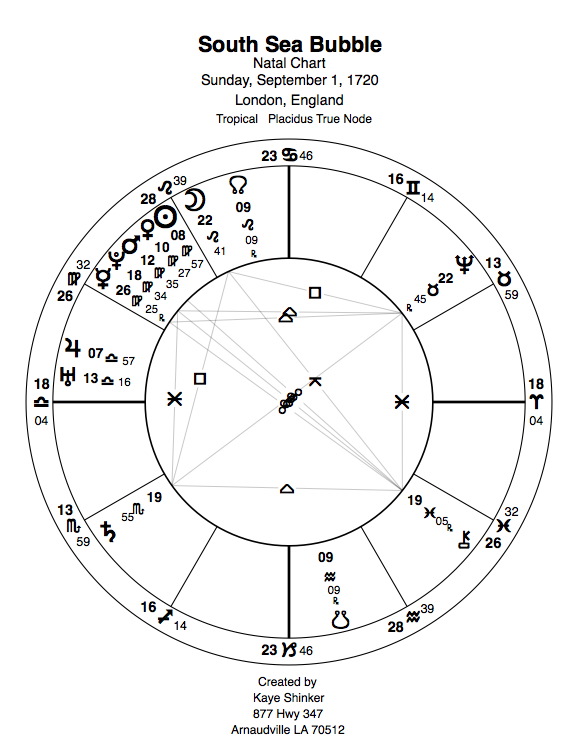
The Tulip Bubble and the South Sea Bubble have one common astrological signature. Jupiter and Uranus are in Aries.

2011 from March until June, Jupiter and Uranus will transit Aries.

This is the challenge: Find the Bubble.


Somewhere in the market place a bubble is forming. Could it be one of the 12,000 stocks listed on the New York exchanges? Could it be a whole sector? Could it be a commodity, a currency, an index, or an entire exchange?


History tells us that when Jupiter and Uranus get together in Aries a bubble forms and bursts toward the end of Jupiter’s transit of Aries, Historians love to site the Tulip Bubble and the South Sea Bubble as examples of foolish investors caught up in the euphoria of making fortunes buying a selling worthless investments. Simultaneously the Mississippi Bubble burst.


From January through June 1928 Jupiter was in Aries and Uranus transited Aries from zero to 8 degrees. No popping bubbles however the markets were soaring and ordinary folks were learning all about margin calls. Eighteen months later the markets collapsed. Since this transit is similar, it could be that nothing will happen and markets will soar while bears keep telling investors keep your stops firmly in place.


Jupiter has transited Aries a few times since 1928. Notable is Oct 19, 1987 when he made an exact trine to Uranus in Sagittarius. The Dow fell 23% and the S&P fell 20%. Jupiter transited Aries again from Feb 15, 1999 to Feb 15 2000. The peak for the Dow Jan 14,200 was 11,733 and the NASDAQ high of 5048 March 10,2000 signaled the bursting of the Dot.Com bubble.


Eyes Wide Open

Jupiter in Aries says open your eyes, snap out of it. Uranus in Aries takes the lid off the box and forces you to stop look and listen to your instincts. Suddenly every investor sees the same bubble and they scramble to the exit losing fortunes as they rush to the sell button on their computer. Will it be a flash crash?


Thousands of rules and regulations have been written to assure investors that bubbles will be discovered before they burst. However in the age of instant communications they could appear one afternoon and burst before daylight. One will be clever enough to make spectacular headlines.


Sector Please?

Maybe we could find some clues from the recent conjunction of Jupiter and Uranus in Aries on June 8, 2010. Summer 2010 and both planets made a two month foray into Aries. Uranus hovered at zero degrees while Jupiter moved all the way to 3 degrees before it turned retrograde and returned to Pisces September 10, 2010.


Summer of 2010 the Dow Jones Index average cruised below 10,500 .and remained there until Sept 13. June 10, 2010 Jupiter and Uranus made a conjunction at zero Aries.The Dow Jones Industrial Average dipped to 9816. Uranus continued to move forward through the zero degree mark and then turned retrograde July 5 and the Dow dipped to 9743.. Everyone expected the Dow to dip further. However Uranus moving retrograde kept the Dow steady hovering around the 10,000 mark until it finally returned to Pisces August 13, 2010.


I suspect that during the summer a bubble began to form either in one sector of the market or among several stocks. During the next month you will see that a number of stocks have increased more than 50% to date. Financial News headlines last summer did not suggest any bubbles were starting to form. Look for a migrating high that does not make sense.


If you have a good idea as to where to look for a bubble, add it to the comments space. Our prize for the best guess is cookies. We e mail the recipe.


Clues check The Textbook for Financial Astrology.


Friday, January 14, 2011

Signs not Constellations

Nothing has changed.

You can change the name of the street but the house hasn't moved. In fact nothing has changed about an individual horoscope or the indication of the skills on an individual investor according to the placement of the planets on their date of birth. Changing the name of a constellation or adding another changes nothing but the street map. ( I used to be a printer and we loved it when the city changed the names of streets. Our company was inundated with all sorts of new orders to replace maps, business cards, stationary)

In fact sometimes I wish the astronomers would rename all of the constellations. Horse is much easier to spell than Sagittarius. However I'm afraid that astrologers would stick to their 2000 year old tradition and I will continue to misspell Sagittarius.

Financial Astrology
is based on the position of planets. We just want to know the exact distance between planets and the sign of the zodiac where they may be found. Our study is based on a Zodiac of Signs.

Astrological investing is based on the position of the planets at each moment in time. Our study is based on a Zodiac of signs, not a zodiac of constellations. We use the signs as a handy reference map to decipher the location of planets. We need to know the measurement of degrees between each planet from the point of view of our position on earth. For example: Right now,
Jupiter and Uranus are conjunct in the 'Sign' Pisces. However, if you wish to find Jupiter and Uranus with your telescope then you will need a current map of the constellations. For financial astrologers the Zodiac signs are like a street map. We use the map to tell us the distance (measured in degrees) between the planets.

Its All in the Aspects
In Financial Astrology we use today's planetary positions to help us determine how the market indexes will move. Jupiter and Uranus have been very close to each other since June. Each time they have been together during the past 100 years the Dow index has gradually moved up.
We have discovered many other useful aphorisms. For example when Jupiter moves through the area of the sky we call Pisces; the price of fuel increases. We have also discovered that companies who have incorporated between February 20 and March 20 usually earn higher profits when Jupiter moves through that portion of the sky named for the sign Pisces.

Accuracy Counts
Financial Astrology relies on the accurate measurement of the degrees between planets. Experience has shown that certain relationships between planets may have a positive or negative effect on the Dow or other indexes. Experience has also shown that the current position of a planet will also effect the price of an individual stock and even the health of a company.
Available on our website you may purchase my Textbook for Financial Astrology. The book explains exactly how we work with planets and signs.

Saturday, April 24, 2010

Be Prepared: Jupiter conjunct Uranus


June 8, 2010, September 19, 2010, and January 4, 2011 Jupiter and Uranus are conjunct.

The conjunction usually signals a rise to a high in the market. This phenomena occurred in 1997 or about 13 years ago. If you had purchased GE, Honeywell or DIA you would have doubled you money and collected a few dividends. No big deal, right?

However during the 13 years since the last conjunction Jupiter made a bunch of aspects to Uranus and even more to his good buddies Saturn and Neptune. You probably would have put firm stops on these stocks in May 2000 when Jupiter and Saturn made a conjunction.

The study of Financial Astrology is about finding an excellent time to buy, sell or hold. It is for folks who like to make their own decisions, read technical charts, study the past performance of a company and then invest.

Be Prepared: Buy the Textbook for Financial Astrology and sign up for classes

There are 7500 stocks on the New York exchange and thousands more around the world. Some are excellent this year and others are struggling and maybe they will be next year's bargain. Often the date the company was incorporated and then offered as an IPO will give you a clue as to their current situation. If you learn to read these charts, you can avoid being caught in the hype of a website article or a broker with a vested interest.

On a personal level astrology can tell you when you will have a difficult year or a joyous one. It can do the same for companies.

What Do the Textbooks Teach?

I finished writing the three sections on the E Book for Textbook for Financial Astrology in 2002. I wrote it for my students, therefore the lessons move from simple to complex. Each lesson has questions at the end giving the student the opportunity to practice that particular concept. Most of my students were able to complete the first three books and develop their skills at buying stocks as an investment.
A few have their own websites and share their knowledge and experience. The Textbooks explain how you take the first steps in the process of learning Financial Astrology. By the time you finish you should be able to read a chart and start making intelligent investment decisions based on timing and market bias.

Each month I try to update everyone in the New Moon report. I give you an overall picture of the how astrological phenomena will effect the markets. Hopefully you can use it to your advantage before you go to your portfolio site and decide whether this is a good time to sell your stocks that are dead money, make a new investment, or hold onto the ones that actually pay a dividend.


Buying or selling stocks especially if you have a long position requires self-disciple, a target date and excellent stops. You knew that, Right?
They teach you timing. They explain when to start a business, whether a stock according to its chart has a chance of increasing in value, and they explain when outside forces can temporarily damage the price of a stock.

One of the clues as to the exact date to buy or sell is planetary phenomena. Jupiter transits like to give you the opportunity to make a profit and Saturn transits like to When I wrote the Textbook for Financial Astrology I arranged the lessons in the order of their importance to buying and selling stock.

Quite a few planetary phenomena have occurred since 1997 and I've had the opportunity to keep my students informed during these cycles.